
Our Patron Saints
The names on this church
Two soldiers
Sixty years apart, two officers of the Roman army were ordered to sacrifice to the gods of the empire. Both refused, said why, and were beheaded for it. This church carries both their names.
They were not bishops or theologians and neither of them wrote anything. What the Church has of them is how they died and what they said before they died, kept in the Synaxarium — the book of the saints, read aloud in the liturgy on the day each of them was killed. The Church calls that day their birth.
Martyrs are not a footnote to Coptic history; they are how the Coptic Church counts time. Its calendar begins in the year 284, the year Diocletian took the throne and the persecution began that killed St. Mina — the Year of the Martyrs, still printed on every Coptic calendar. To name a church for two of them is to ask for their prayers, and to keep their days.
About 225 to 250
St. Philopater Mercurius
Abu Sefein — father of the two swords
Philopater is Greek for lover of the Father, and it is the name his Christian parents gave him. The accounts differ on where they lived: the Synaxarium read in the Coptic Church puts the family in Rome, and the Greek accounts put them in Cappadocia. From his enlistment on they agree.
He joined the army at seventeen, under the emperor Decius, and was quickly known for it. On a campaign against the barbarians an angel in white stood in front of him and held out a sword, saying: when you have overcome your enemies, remember the Lord your God. The Romans won the battle, and the emperor made him a commander.
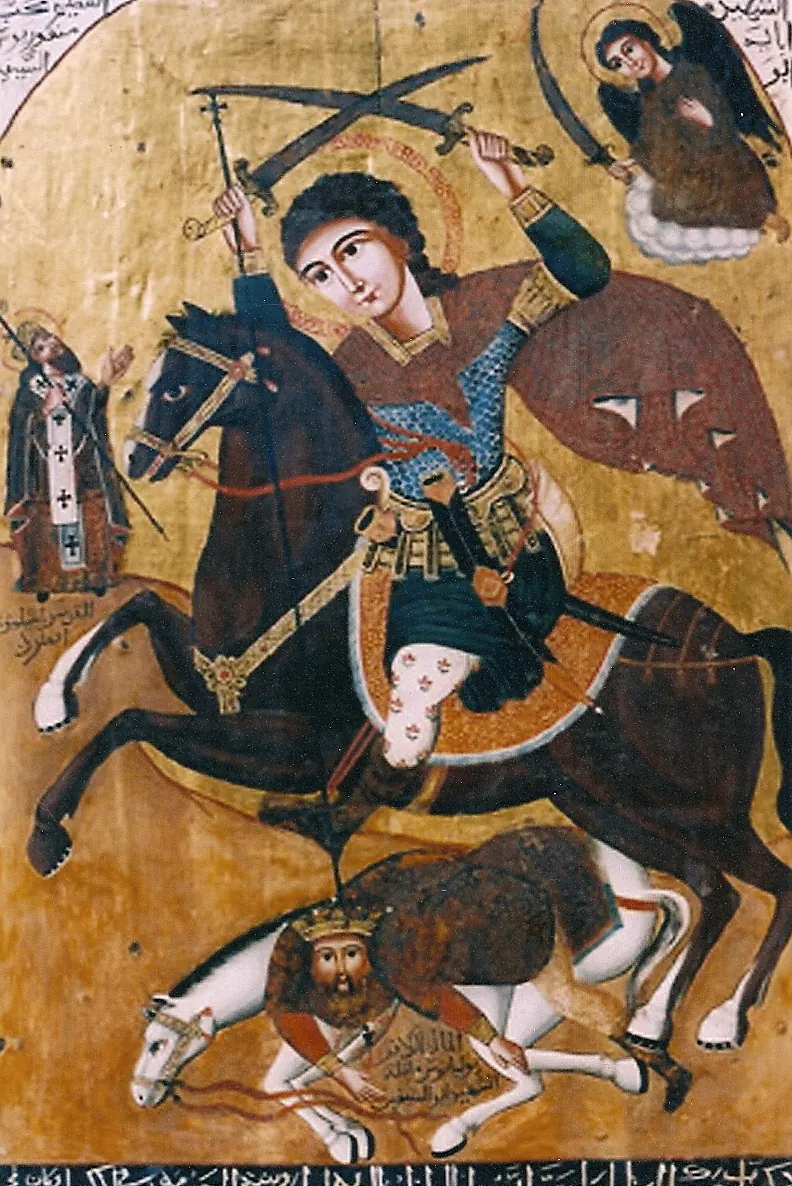
He now had two swords — the one the army had issued him and the one the angel had brought. That is where the name he is usually called by comes from. In Egypt he is Abu Sefein, أبو سيفين, the father of the two swords, and it is the two swords, not the sword, that the icons put in his hands.
Then Decius went to the temple to burn incense and sent for him. He did not come. Asked why, he said that he worshipped no one except his Lord and his God Jesus Christ. He was stripped of his rank, beaten and imprisoned. The emperor did not kill him in Rome — the soldiers and the city were fond of him — so he was sent in irons to Caesarea in Cappadocia and beheaded there, on 25 Hathor, in about the year 250. He was twenty-five.
The emperor under the horse
A hundred years later a second story attaches to him. Julian, the emperor who tried to give the empire back its old gods, marched east against Persia and did not return: he was killed by a spear thrown by someone nobody ever identified. What the Church in Cappadocia said was that St. Basil had prayed before the martyr's icon for the Church's deliverance, and that the spear in the icon came back wet.
The Church has never made a doctrine of that. It has painted it for sixteen centuries, which is why there is a crowned man falling under the horse in nearly every icon of St. Mercurius, and a bishop watching from the edge of the frame.
Where he is now
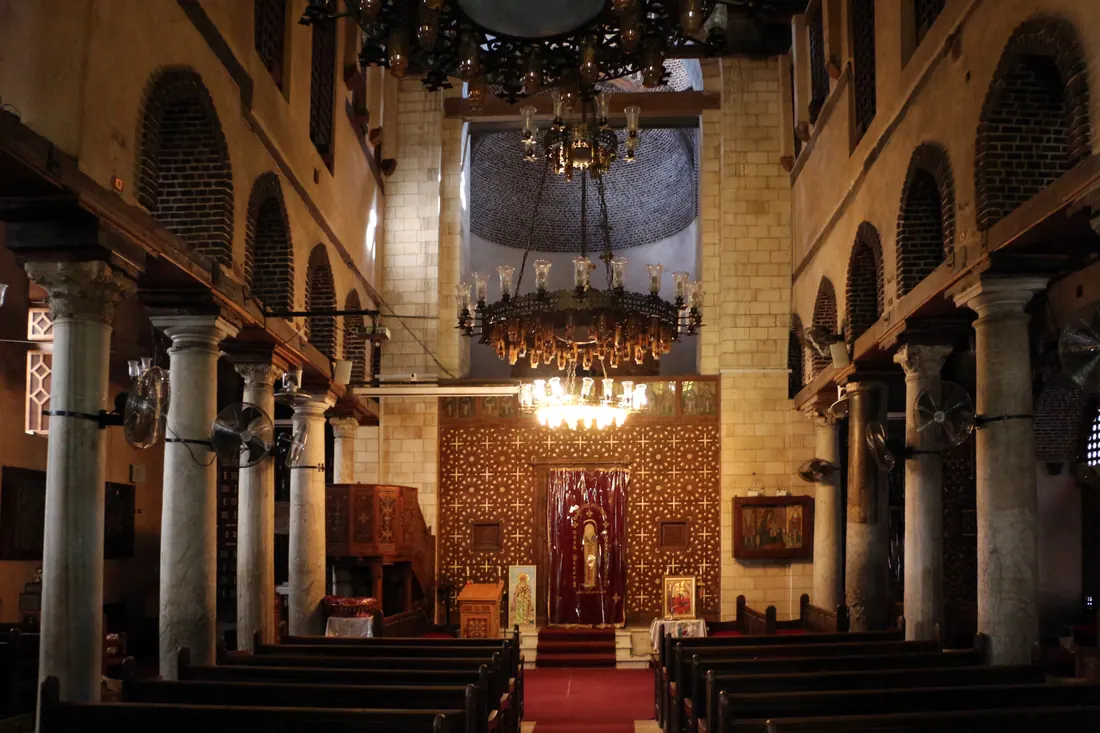
His relics are in Old Cairo, in the church that carries his name inside the walled compound Egyptians call Dayr Abu Sefein. A convent stands beside it, and the church is one of the oldest still in use in the city.
The Church keeps
- 25 Hathor4 December
- His martyrdom
- 25 Abib1 August
- The consecration of his church
About 285 to 309
St. Mina the Wonder-worker
Mari Mina el-Agaiby — Mina the miraculous
He was born at Niceous in the Delta, the son of Eudoxius, who governed the town, and of Euphemia, who had no children for years. The Synaxarium says she prayed in front of an icon of the Virgin and heard the answer Amen, and that they took the boy's name from it.
His father died when he was a boy. At fifteen he went into the army and was posted to Cotyaeum, in Phrygia. When Diocletian's edict against the Christians reached the garrison he handed back the belt of his rank and walked into the desert, where he stayed five years. There he saw the martyrs receiving their crowns, and he went back to the city.
He walked into a public festival, in the middle of the crowd, and said out loud that he was a Christian. He was offered position and threatened by turns, then tortured, then beheaded, in about the year 309. His body was thrown on a fire and the fire did not consume it; his sister recovered it and brought it home by ship to Alexandria.
The camel that stopped
The body was loaded onto a camel to be carried out into the western desert. At a place near Lake Mariout the camel knelt and would not go on, and no other beast they loaded would go on either. They took that for the answer and buried him there.
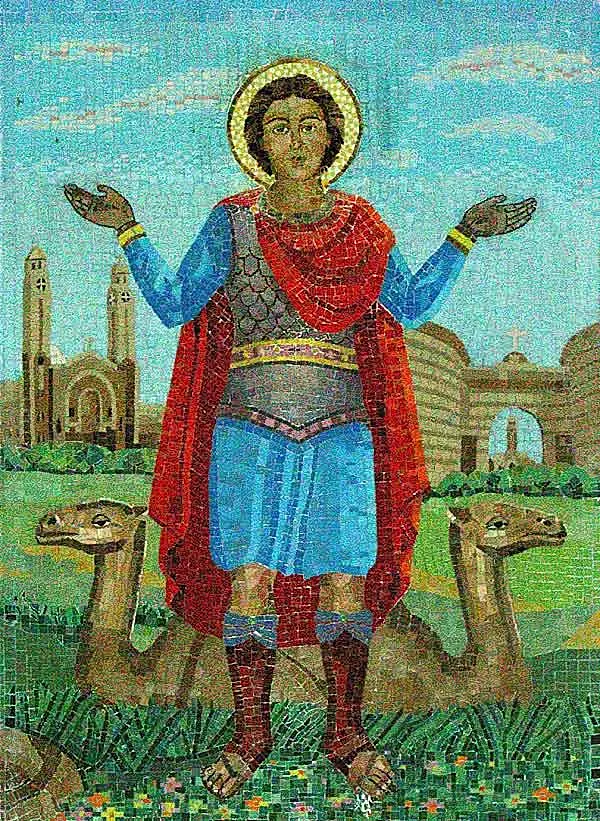
Later a sick animal was made well in that ground, and then people were, and a church was built over the grave and consecrated on 15 Paoni. A city grew up around it — a great basilica, baths, hostels, workshops, a street of shops for pilgrims — and the pilgrims carried the water and the oil of the shrine home in small clay flasks stamped with a picture of him standing between two kneeling camels. Those flasks have been dug up in Italy, in Germany, in France, which is how far the news of an Egyptian soldier's grave travelled.
Abu Mina now
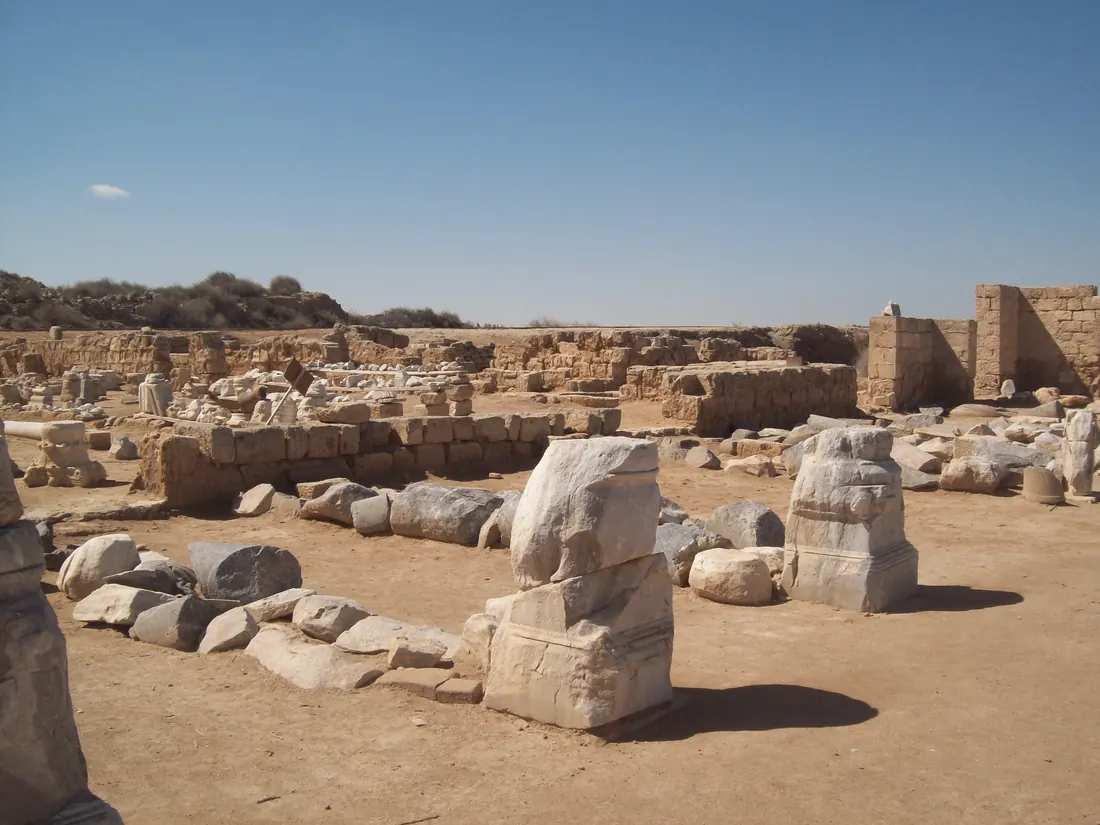
The pilgrim city was ruined and the desert took it back. It was dug out again at the beginning of the twentieth century, and the site is a World Heritage site today — and on the list of those in danger, because irrigation in the fields around it has raised the water table under the foundations.
A short distance away is the monastery Pope Cyril VI began building in 1959. The relics of St. Mina are kept there, and Pope Cyril VI is buried there himself.
The Church keeps
- 15 Hathor24 November
- His martyrdom
- 15 Paoni22 June
- The consecration of his church at Mariout
In the icons
How to tell them apart
Both are painted as soldiers, and they are never painted the same way.
St. Mercurius is moving. He is on a black horse with a sword raised in each hand, an angel over his shoulder holding out the second one, and a crowned man going down under the hooves. Everything in the frame is the moment after something happened.
St. Mina is standing still. His hands are open and lifted at his sides — the way the early Church is shown praying, before folded hands — and a camel kneels on either side of him. He is almost never shown without them.
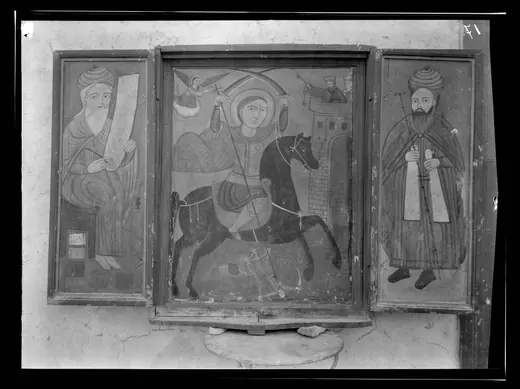
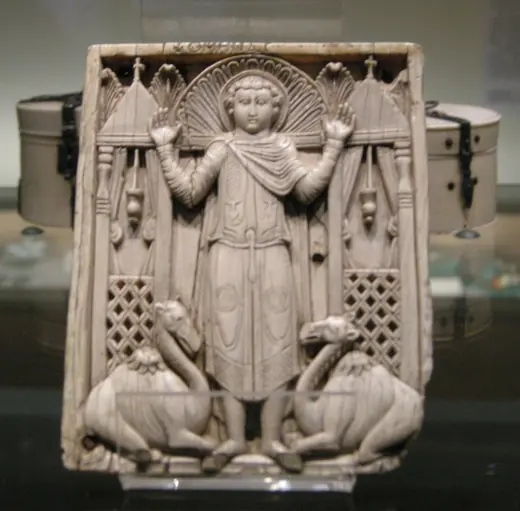
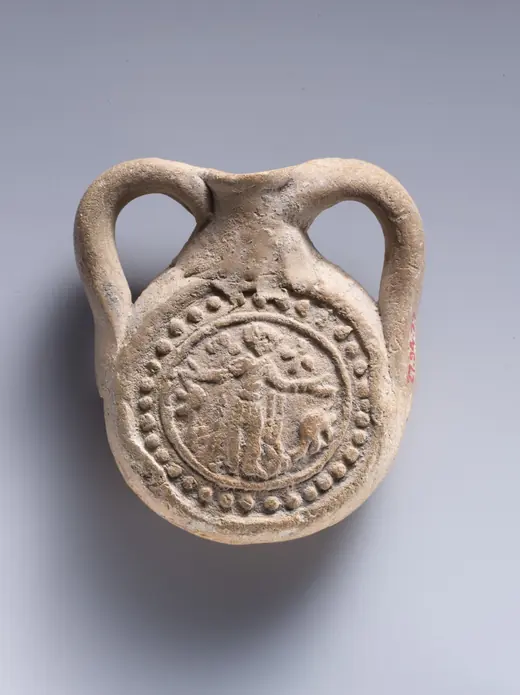
None of these pictures is of this church. They are from Wikimedia Commons — icons, museum objects and an excavated site — and each is public domain, CC0, CC BY or CC BY‑SA, linked below to its source and its licence.
More about the church
- Who we areA Coptic Orthodox church in Wayland, Massachusetts, and the Church it belongs to.
- Our beliefWhat the Coptic Orthodox Church confesses, and where that confession comes from.
- Welcome newcomersWhat happens in the liturgy, and what to expect if you have not been before.
- Future plansWhat the church is building, and where the work stands.